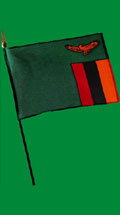
16 October 2003
Had lunch today with two representatives of a major international non-governmental organization (which, for our purposes today, shall remain nameless). They took turns tearing into Zambia's problems -- a pathetic economy, political corruption, educational collapse, rampant disease, drought, floods, starvation. One told the tale of a Norwegian fellow arrested a few weeks ago on trumped-up charges (for arguing with a cabbie who ripped him off), secretly held in jail overnight, and released only after a friend gave a bribe of 20,000 kwacha (all of four American dollars). She was clearly disgusted with the place.
I asked: "Is there any reason at all to be optimistic about this country?"
Her reply: "Well, the sun is shining."
Some of you may be wondering why I picked Zambia as the site of my fellowship. One reason is that the country's failure seems so nonsensical. Think of what the country has in its favor: It's English-speaking, a major plus in the world economic environment. Unlike so many of its neighbors (Angola, Congo, Madagascar), it hasn't been crippled by civil war. Unlike its fellow former British colonies (Zimbabwe, South Africa), it isn't shackled with a poisonous racial environment. It didn't have to fight for its independence 39 years ago, and it hasn't been at war in the years since. And when it emerged as a nation in 1964, it was (by African standards, at least) pretty well-off -- it's income levels were the second highest on the continent, behind South Africa.
But since then, the place has gone into the tank. Sure, there are reasons: The economy at independence was based entirely on copper exports, and the price of copper took a dive in the 1970s and has never recovered. The government quickly abandoned an early investment in education, stopping the black middle class before it ever started. And HIV/AIDS has been tough and will only get (much) worse over the next decade. But I just can't gather up much optimism for the place's future. I mean, if Mugabe ever gets tossed in Zimbabwe, you know that they'll have a chance to recover. If the new guy in Liberia can settle things down, you can see how that country might make strides forward. If Congo can stop the bleeding and get some stability, it's got the natural resources to be a regional power. But Zambia just seems like a sad case.
Then again, just a couple posts ago, I was criticizing a backpacker for making judgments about a country just after landing, so maybe I should shut up. There are good people working to fix all these problems, and they just might figure something out yet.
Today was my first big day of interviews, starting at 7:30 a.m. I was meeting two 40-something Zambians to talk about AIDS and set up some further interviews. Yesterday, Felix and Israel had suggested we meet at the Helen Kaunda Bus Station. I told my taxi driver that this morning, and he was confused: Why is this white guy going to Helen Kaunda?
Turns out the Helen Kaunda Bus Station isn't a building at all, just an indentation in the curb on a dusty road. (Then again, they're all dusty roads. I'm going to need better adjectives than that to make it through the next six weeks.) Helen Kaunda was the mother of Kenneth Kaunda, the man who won Zambia's independence and was its president/socialist-humanist autocrat for almost three decades. Her bus station is really just a bus stop, unmarked at that.
In any event, that interview turned out quite different than I'd expected. I thought I'd arranged to meet with someone whose sister had died of AIDS. (Nope, miscommunication with Felix.) Then I gathered (from context in things Felix said) that Israel was HIV positive. But I wasn't sure, so I had to ask. He isn't. (Few things are more awkward than feeling a twinge of disappointment when learning someone isn't HIV positive. We journalists are vultures, aren't we?)
Anyway, from there went for a briefing with Nameless Non-Governmental Organization, then ended up with some interviews at the Ministry of Education. I've been happy so far to see that government officials, at least, aren't afraid to speak the truth about the country's AIDS crisis. If I can get a similar level of honesty out of schools and teachers, I'll be all set.
Anyway, back at Chachacha, the utterly obligatory Bob Marley is blaring from the stereo. I think they remove your hostel from the next edition of Lonely Planet if you don't play Legend in its entirety at least once a week. Chachacha is safe until next Wednesday, at least.
15 October 2003
On a different tack altogether, two non-Zambia questions for the audience:
- F.O.Z. (Friend of Zambiastories.com) Kim has pointed out that the red-links-on-green-background motif of this site gives her a headache. I agree -- while I was trying to match the color scheme of the Zambian flag, the red is largely a holdover from the crabwalk.com code I so ruthlessly stole when setting up this site. So, any HTMLers who have a better idea than the current red are encouraged to speak up.
- My iBook's power supply is rated for both American voltage and European (220V, which is what Zambia has -- along with those freaky S&M U.K. three-prong plugs). But when I charge my laptop, it gets freaky hot. As in, no longer tolerable on my lap and hotter than what I'm used to from standard charging and use in the States. (Most of the heat comes from the hard drive, not the battery.) Is this problematic? Should I be using a voltage converter even if it's technically unnecessary? Will my laptop self-destruct in 30 seconds? All advice welcome.
Just to add to the freakiness, I bought a new battery for this thing a week before I left D.C., and it's about a millimeter too thick. It fits in the battery slot, but when it's in, I can't press the right side of the trackpad button.
(One plus of 220V: the battery recharges from empty in barely 90 minutes. It takes well over two hours in America.)
14 October 2003
One housekeeping note: As some of you know, I'm in Zambia as part of a Pew Fellowship in International Journalism. But I'm not the only one!
I set up blogs for six of my fellow Fellows as they roam the globe on their fellowships. You, dear reader, are the beneficiary! Two of them already have posts:
- MJF on Iran (I'm not using her full name so the Iranian Googlebots don't find her)
- Noel Paul on Russia
Four others will launch soon: Antrim Caskey on Argentina, Suzanne Marmion on Iran and Egypt, Jeremy Kahn on Ivory Coast, and Jessie Deeter on Sierra Leone. (Don't mind the test posts at those links at the moment.)
The Lusaka airport has the same sort of shabby charm as most Third World airports I've been to. It's the first impression of most foreign tourists to Zambia, so the government has tried to make it an imposing '60s-style building. But no one would confuse it with Heathrow.
When you approach the immigration desk, you're confronted with what appears to be the airport's official welcoming art, a painting by Stepphen Kaputa, "Zambia's foremost native artist," entitled "We Welcome You to Our Safari Lodges in Zambia." It depicts a scene straight out of a Cecil Rhodes fever dream: a half-dozen fat, middle-aged white tourists being served drinks and toured around by happy natives.
The other big sign at immigration is one directed at what appears to be a group of Habitat for Humanity folks who are building some local homes: "Lusaka welcomes the volunteers." Together, the signs sum up what has, unfortunately, been Zambia's relationship with the non-African world for the last few decades -- a spot for occasional tourism and all-too-regular charity.
It's about a 15-minute drive into the city center from the airport. Along the way, my taxi must have passed 10 foreign charity operations. A CDC/NIH facility treating TB. An anti-poverty program run by the Japanese government. A Programme Against Malnutrition center. Later in the day, I'd talk to an American woman doing work for PAM, and she said Zambia is almost unique among even African nations: "It's just about the only place that's been going downhill for 30 years. No up and down -- just down."
I don't know enough to say how unique Zambia's situation truly is, but I can tell you that on the UN's Human Development Index -- a measure of how easy it is for someone in a country to live a long, educated, and at least moderately prosperous life -- Zambia's been a global lagger. It was the only country in the world with a lower HDI in 1995 than it had in 1975. And while there's been a little progress since then, AIDS is sure to knock the country back down again.
I had been planning on staying at the Holiday Inn Lusaka, a bland, soulless, but assuredly comfortable place. But on the flight from London, I came to the conclusion that I'd rather save a little cash. (Since the only people who stay at the Holiday Inn are traveling businessmen with expense accounts, they don't have any problem charging $150 a night. For one night, that's one thing -- for a six-week stay, it's clearly untenable.)
So I detoured to Chachacha Backpackers on Mulombwa Close. As a rule, I don't much like backpacker places, and as the Lonely Planet-blessed place to stay in town ("Without doubt, this well-established place is the best in Lusaka for budget travellers"), Chachacha is overrun with the habitually unbathed. Much of the place smells like a toilet, and what doesn't is coated with a layer of dirt. But, hey, it's hard to beat $6 a night, right?
It was only six bucks because they didn't have any single rooms, just dorm beds. ("You never know -- the other beds might be filled with Swedish 18-year-olds," advised the place's owner, Aussie ex-pat Wade.) It was now about 8 a.m. Sunday, and I hadn't slept since Thursday night. So I took my chances with the dorm room.
Unfortunately, standing in my way was Benson, a 25-year-old University of Zambia student who somehow learned in the five minutes between my check-in and the prospective start of my REM sleep that I was a journalist. Benson pays for his tuition by showing Chachacha tourists around Lusaka -- he and a friend have a flier posted on the common room's wall saying "We are the friendly local guys, and we would like to show you the city."
But Benson's true love is research. He's trained to be a librarian, but he said librarians don't make any money. He asked about the stories I planned to write, and he quickly proposed showing me around, pointing me toward interviews, looking up statistics for me, and so on. Sounds good, I thought. Let's talk tomorrow.
"Oh, come on, it's a free day! Let's go looking now!"
Um, no.
"Seriously -- it's a beautiful day. [It was.] Let's go!"
It took about 25 minutes of convincing to get him to acknowledge I wasn't going to do anything more than saw logs today. Finally I made it to bed.
Woke up about eight hours later and wandered around. Had a few beers at the bar (the local brew is called a Mosi, named for Mosi-oa-Tunya, the local name for Victoria Falls). Got poked fun at for reading PDF files with names like "Educator Mortality In-Service in KwaZulu Natal: A Consolidated Study of HIV/AIDS Impact and Trends" when I could be acting like all the other backpackers, which would mean either:
- Getting sloppy drunk and telling the same untrue tales of your global "adventures" you've been spinning for the last nine weeks -- coincidentally, the same span of time since you last washed your shirt.
- Making profound proclamations about the Zambian people ("They just don't have that go-get-'em attitude") after six hours in country and a quick skim of the Lonely Planet's "Facts for the Visitor" section.
- Scamming on the Scandinavian girls, who I'm sure have nothing better to do than hook up with fat 40-something Germans.
I went back to sleep, but that only lasted a few hours (surprise) before awaking at 2 a.m. Luckily, the Congolese salesman at the Radio Shack back in D.C. advised me to buy a shortwave radio for this trip, so I listened to a couple hours of BBC World Service on headphones before sunrise.
I'm not sure if it's just this time of year, but the sun's on an early cycle here. It seems to rise at about 5:30 a.m. and set around 6:00 p.m. It's actually fitting in quite well with my jet lag.
Yesterday (Monday) morning, Benson was ready to go. We took a five-hour walking tour of the city, which left me with (a) a sunburn, (b) my official Zambian press pass (my passport photo gluesticked to a piece of yellow cardboard -- it looks like a press pass for an elementary school), and (c) a cell phone. I don't believe it's working yet, but my phone number is (+260) 097 815475.
Back in the states, I'd read a lot about how crowded and charmless Lusaka was. As the economy's tanked in the 1990s, rural Zambians have clustered in the capital (following the ancient Third World paradigm that wherever the government is, that's where the money is), and the population's zoomed upward. But the streets were almost empty across most of town. We wandered past some of the places where I'll be reporting later (University Teaching Hospital, the UN complex, the American embassy). Zambians were reported to be a friendly people, and I've seen nothing to contradict that.
At day's end, I realized I hadn't had anything to eat since arriving in Zambia. (Those of you who know me realize that me not eating for 36 hours is something of a feat.) Part of me wanted to start off my trip with traditional Zambian cuisine (which primarily revolves around something called nshima, a cornmeal-based dough). But I figure I've got plenty of time for that, and when I venture outside Lusaka to rural areas, nshima will probably be all I can get. So I didn't feel at all guilty about catching a cab to Danny's over on Haile Selassie Road, the city's finest Indian restaurant. Mmmmm...chicken tikka massala.
12 October 2003
I know that the next six weeks of posts will be filled with intricate details of Zambian culture, extensive epidemiological studies of sub-Saharan HIV strains, and Serious Journalism -- so I figure I'm allowed a moment of boyish excitement before I hit the hard stuff:
I have been in Kate Beckinsale's bedroom.
To explain: My flight plan first took me from Washington, D.C., to London, where I had a 12-hour layover. I'd planned to bum around the city aimlessly, with my only planned event being grabbing lunch with Tod, my newspaper's London bureau chief. But a happy change of circumstances meant I ended up wandering around town all day long with Tod, his awesome nine-year-old daughter Fiona, and two of Tod's journalist friends. Along with swapping a bushel of old foreign correspondent stories, we even tracked down David Blaine, Mr. Starving Suspended Magician. A good time was had by all (or at least me).
But the single most exciting moment came early on, when Tod offhandedly mentioned that the house (which he bought a couple months ago) was until recently occupied by Ms. Beckinsale, a starlet who had been a minor obsession of mine since The Last Days of Disco. (Oxford-educated, cute as hell -- how can you go wrong?) I could have phrased my day's greatest excitement in a variety of ways ("I've used Kate Beckinsale's bathroom," "I've eaten a croissant in Kate Beckinsale's kitchen," etc.), but the bedroom mention seemed most inappropriate.
After my excitement subsided, I hopped on another plane and, 10 hours later, landed in Lusaka at about 6:15 a.m. this morning. First impressions of Zambia later.